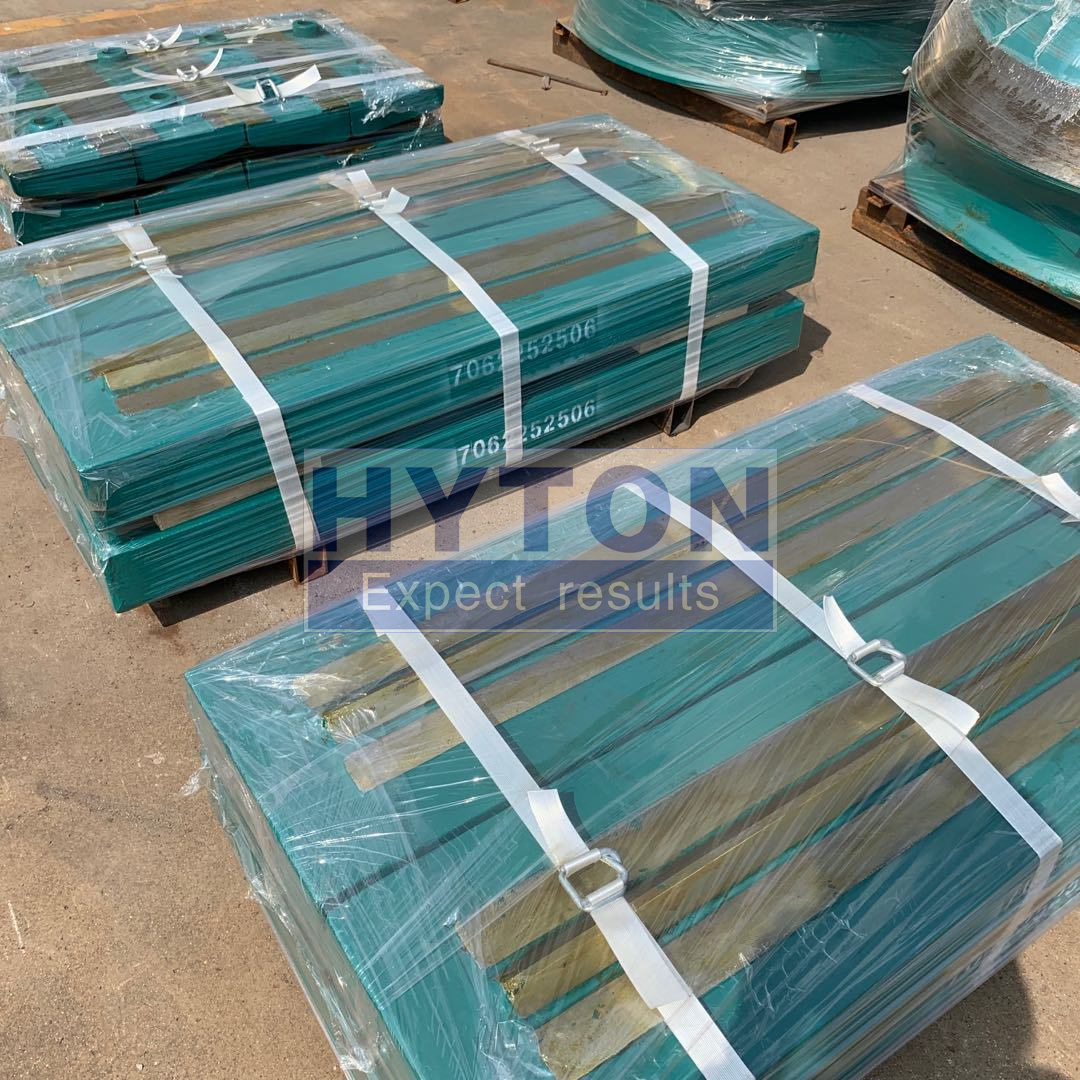
Many customers ask: Why do some impact crusher blow bars last much longer than others under similar conditions?
The service life of a blow bar is not determined only by quality, but also by material selection, application conditions, manufacturing process, and equipment operation. Choosing the right solution for the actual crushing environment is the key to achieving optimal performance.
1. Material Selection Determines Performance
The first step to improving blow bar performance is choosing the right material. Different crushing applications, feed sizes, and material characteristics require different wear solutions.
Common blow bar materials include high manganese steel, high chrome iron, martensitic steel, and ceramic reinforced materials.
High manganese steel offers excellent toughness and impact resistance, making it suitable for high-impact applications. Its wear resistance depends on work hardening, so sufficient impact is required to achieve better performance.
High chrome iron provides outstanding wear resistance for highly abrasive materials. However, its lower toughness requires careful evaluation under large feed sizes or heavy impact conditions.
Martensitic steel provides a balance between hardness and toughness, offering improved wear resistance while maintaining good impact resistance.
For more demanding applications, martensitic steel with ceramic inserts combines steel toughness with ceramic wear resistance, providing a longer service life under severe conditions.
Therefore, the hardest material is not always the best choice. The right material should be selected based on:
Feed size;
Material hardness and abrasiveness;
Crusher application;
Impact conditions;
Required service life.
2. Manufacturing Process Ensures Product Reliability
After material selection, manufacturing quality plays an equally important role.
A reliable blow bar requires strict control throughout the entire casting process, including:
Pattern and mold preparation;
Molding process;
Alloy melting and chemical composition control;
Heat treatment;
Machining;
Final inspection.
Proper heat treatment improves the internal structure of the material, ensuring the designed balance between hardness and toughness.
Comprehensive inspection methods, including hardness testing, chemical analysis, metallographic examination, dimensional inspection, and non-destructive testing, help guarantee consistent product performance.
3. Operation Conditions Also Affect Service Life
Even a high-quality blow bar can experience reduced service life if operating conditions are unsuitable.
Factors such as:
Incorrect installation;
Uneven feeding;
Rotor imbalance;
Excessive rotor speed;
Changes in feed material;
can all accelerate wear or cause unexpected damage.
At Hyton, NP-CI series impact crusher blow bars are developed with a focus on proper material selection, controlled casting processes, and strict quality inspection to help customers achieve reliable performance and longer service life.
Choosing the right blow bar is not only about selecting a wear-resistant material — it is about finding the best solution for your specific crushing application.