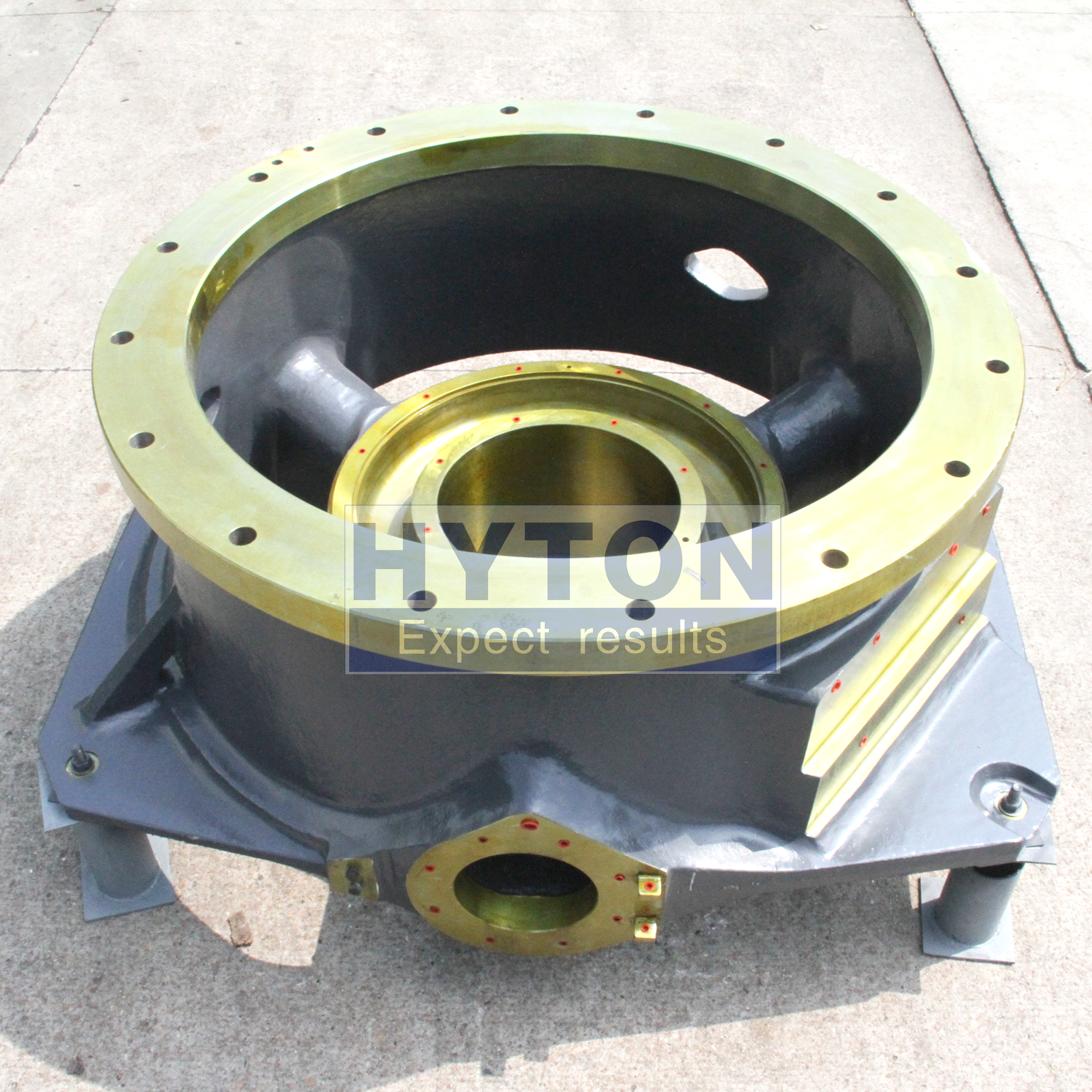
 Introduction
In mining operations, many equipment managers encounter a seemingly simple yet difficult question:
Under similar working conditions and with the same crusher model, some bottom shells operate reliably for over ten years, while others develop cracks, deformation, or even fail within just one or two years.
From an external perspective, these components often appear nearly identical. However, their actual performance differs significantly.
So, what causes this difference?
1. Bottom Shell: A Critically Underrated Structural Component
In many cases, the bottom shell is considered merely a “supporting structure,” rather than a critical component. From an engineering perspective, this is a misconception.
The bottom shell serves three essential functions:
It carries impact loads and cyclic stresses generated in the crushing chamber.
It supports key rotating components, including the eccentric assembly, main shaft, and bearings.
It determines the alignment and geometric accuracy of the entire crusher.
In other words, the bottom shell is not only a load-bearing structure but also the geometric reference foundation of the machine.
Even minor deformation or misalignment can propagate through the system, leading to:
In practice: Failures related to the bottom shell rarely occur in isolation — they manifest as system-level problems.
2. Structural Design: Essentially Stress Distribution Design
A well-designed bottom shell is not simply “heavier” or “thicker.” Its effectiveness lies in how it manages stress distribution.
In modern designs, multi-arm structures (typically 5-arm or 6-arm configurations) are commonly used to:
Distribute impact loads spatially.
Reduce local stress concentration.
Delay fatigue crack initiation and propagation.
If the structure is not properly designed, stress tends to concentrate in specific regions — which often become the origin of cracks.
Therefore, structural design is fundamentally about stress distribution, not just strength.
3. Material and Casting: The Foundation of Long-Term Load Capacity
Bottom shells are typically manufactured using high-strength cast steel such as GS20Mn5N (equivalent to GS200+N), widely used in heavy-duty mining equipment and load-bearing structures.
Based on chemical composition testing of a batch of bottom shell materials from our production, the typical composition is as follows:
| Material % | C | Si | Mn | P | S | Cr | Mo | Ni |
0.17-0.23 | ≤0.60 | 1.00-1.50 | ≤0.020 | ≤0.015 | ≤0.30 | ≤0.15 | ≤0.40 |
Result | 0.19 | 0.52 | 1.45 | 0.011 | 0.0071 | 0.16 | 0.075 | 0.14 |
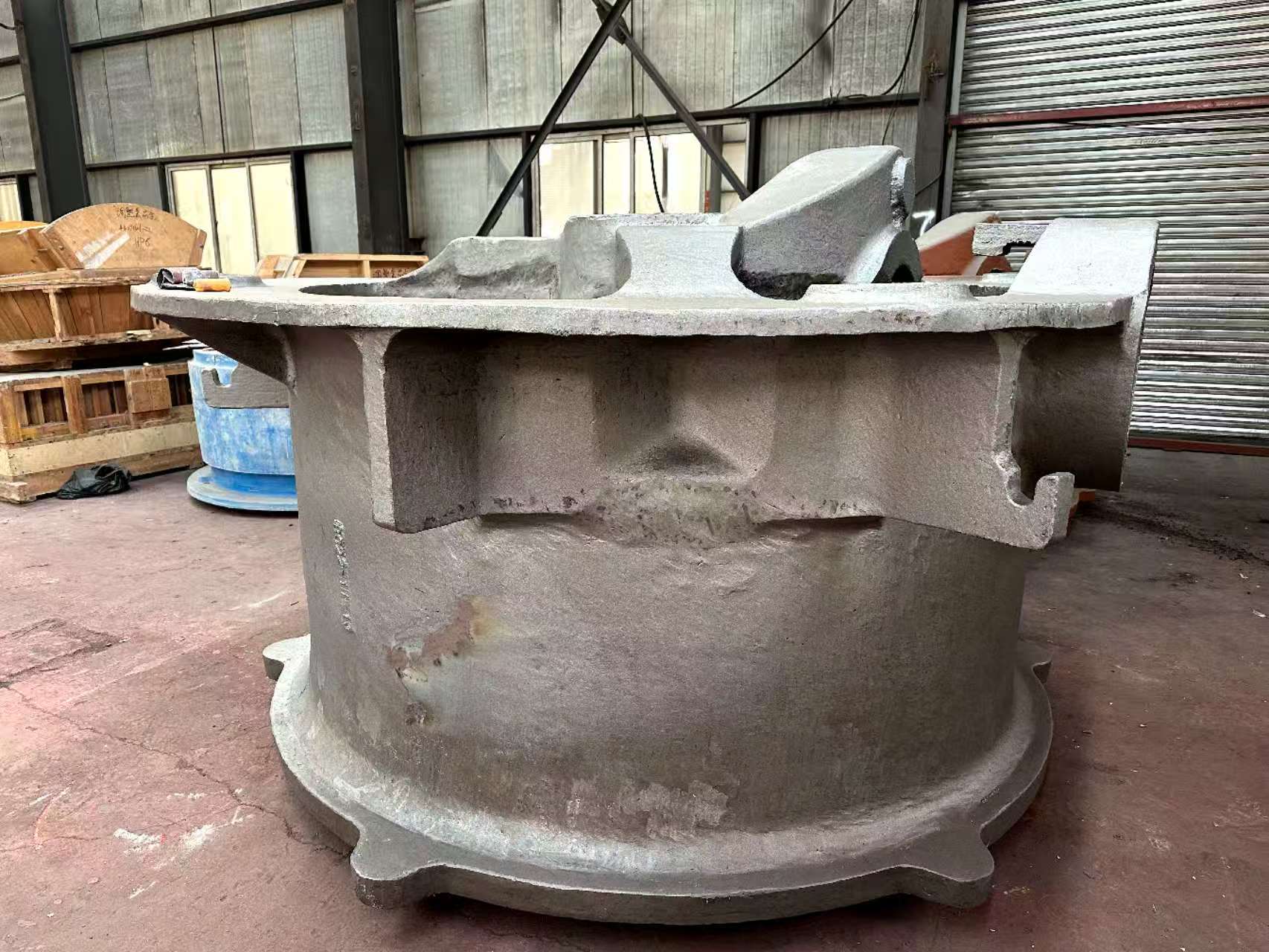 These values fully comply with GS20Mn5N standards, with optimized levels of key alloying elements (Mn, Mo, Ni) to achieve a balanced combination of strength, toughness, and fatigue resistance
(1)High Strength and Fatigue Resistance
During operation, the bottom shell is subjected to continuous cyclic loading from the eccentric mechanism. Typical failure modes involve fatigue cracking.
This enables the material to maintain stable mechanical performance under long-term cyclic stress.
(2)Excellent Toughness and Crack Resistance
The addition of Ni (0.14%) improves material toughness, allowing it to:
(3)Low Impurity Content for Structural Integrity
Measured values of :
This helps to:
(4) Good Machining and Heat Treatment Stability
GS20Mn5N offers excellent processability:
Suitable for stress-relief heat treatment.
Stable machining performance.
Good dimensional stability.
This is especially critical for bottom shells, which function as both load-bearing components and precision references.
(5) Casting Quality: The Key to Actual Service Life
For large structural castings, material properties alone are not sufficient — casting quality is equally critical.
If not properly controlled, defects such as:
Porosity.
Shrinkage.
Inclusions.
These defects are often not visible initially but can develop into crack initiation points under cyclic loading.
Therefore, many so-called “sudden failures” are, in reality:
The result of internal defects formed during casting and gradually amplified during service.
4. Heat Treatment: A Hidden but Critical Factor
Large castings inherently contain residual stresses after solidification.
Without proper stress-relief heat treatment, these stresses may be released during operation, causing:
Structural deformation.
Loss of alignment.
This can further lead to:
Thus, heat treatment is not optional — it is essential for long-term structural stability.
5. Machining Accuracy: The Key to Performance
If material determines whether a component can function, machining accuracy determines how well and how long it will perform.
The bottom shell acts as a precision reference component, with critical machining areas including:
These features require strict control of alignment and dimensional tolerances.
In practice, many equipment issues are not caused by material defects, but by insufficient machining accuracy, resulting in:
In essence:
Most complex mechanical issues are, at their core, precision issues.
6. Lubrication and Internal Design: Ensuring Long-Term Stability
The bottom shell also plays a role in the lubrication system.
Proper oil channel design helps to:
If lubrication is inadequate, it can directly result in:
Elevated temperatures.
Oil film breakdown.
Bearing failure.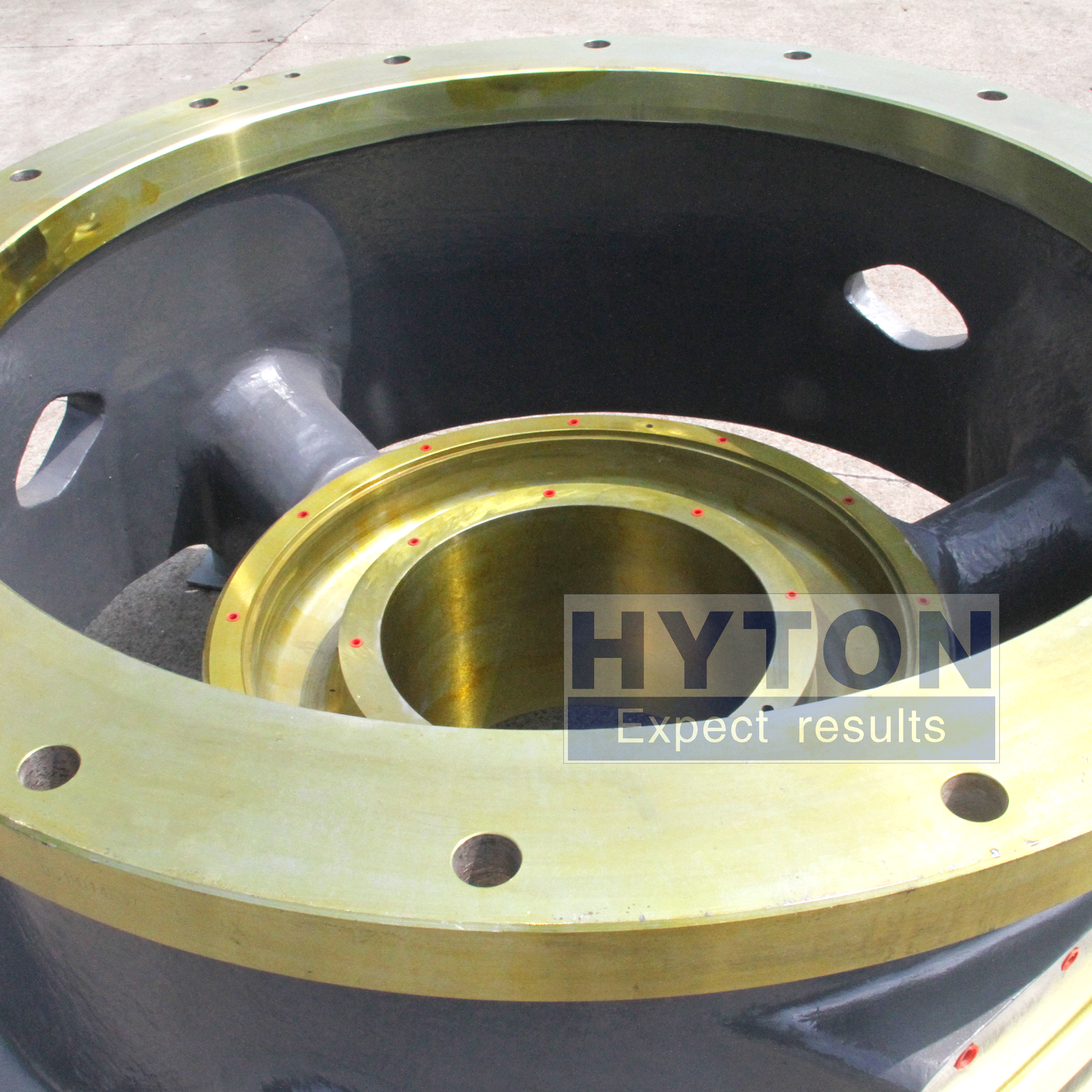
7. Why Do Some Bottom Shells Fail Prematurely?
Based on field experience, early failures are typically caused by a combination of factors:
Inconsistent material quality
These factors often interact, leading to structural failure.
8. Conclusion: Structural Components Define the Machine’s Limits
In cone crushers:
Wear parts determine cost, but structural components determine service life.
The bottom shell, as the structural foundation, defines the upper limit of machine performance and reliability.
It is not merely a supporting part — it is the core element that determines whether a crusher can operate stably over the long term.
Hyton provides one-stop wear and spare parts solution for CH&CS series cone crushers. Here are the specific part numbers for the CH&CS series Bottom Shell. Please refer to them:
CH&CS Series Cone Crusher Parts Number |
Model | Bottom Shell Assembly/Bottom Shell |
CH420 | HT-442.9871-00 |
CH430 | HT-442.7908-901 |
|
CH440 | HT-452.0230-901 |
CS420 | HT-442.9871-00 |
CS430 | HT-442.7908-00 |
CS440 | HT-452.0230-901 |
CS660 | HT-442.8735-01 |
CH540 | HT-BG00373808 |
CH550 | HT-452.8354-901 |
CH660 | HT-452.4125-901 |
CH840 | HT-452.8354-901 |
CH865 | HT-BG00134129 |
|
CH870 | HT-452.0675-001 |
H8800 | HT-452.0642-901 |
CH890 | HT-452.5824-901 |
|
CH895 | HT-452.5824-901 |
Next Article Preview
Structural Analysis of HP Series Main Frames: Why the main frame design directly determines crusher reliability and maintenance costs.